Looking back from 2026, the journey of Hollow Knight: Silksong still feels monumental. Its release in September 2024 was a landmark event in gaming, not just for its critical acclaim but for the sheer cultural impact it had—crashing storefronts and capturing the hearts of millions in a matter of days. As a player who was there from the beginning, I remember the electric anticipation and the collective relief and joy when Hornet finally took center stage in her own adventure. Now, with the dust settled and the game cemented as a modern classic, the reflections from its creators, Team Cherry, offer a fascinating glimpse into the philosophy that shaped this beloved world and what it might mean for the future.
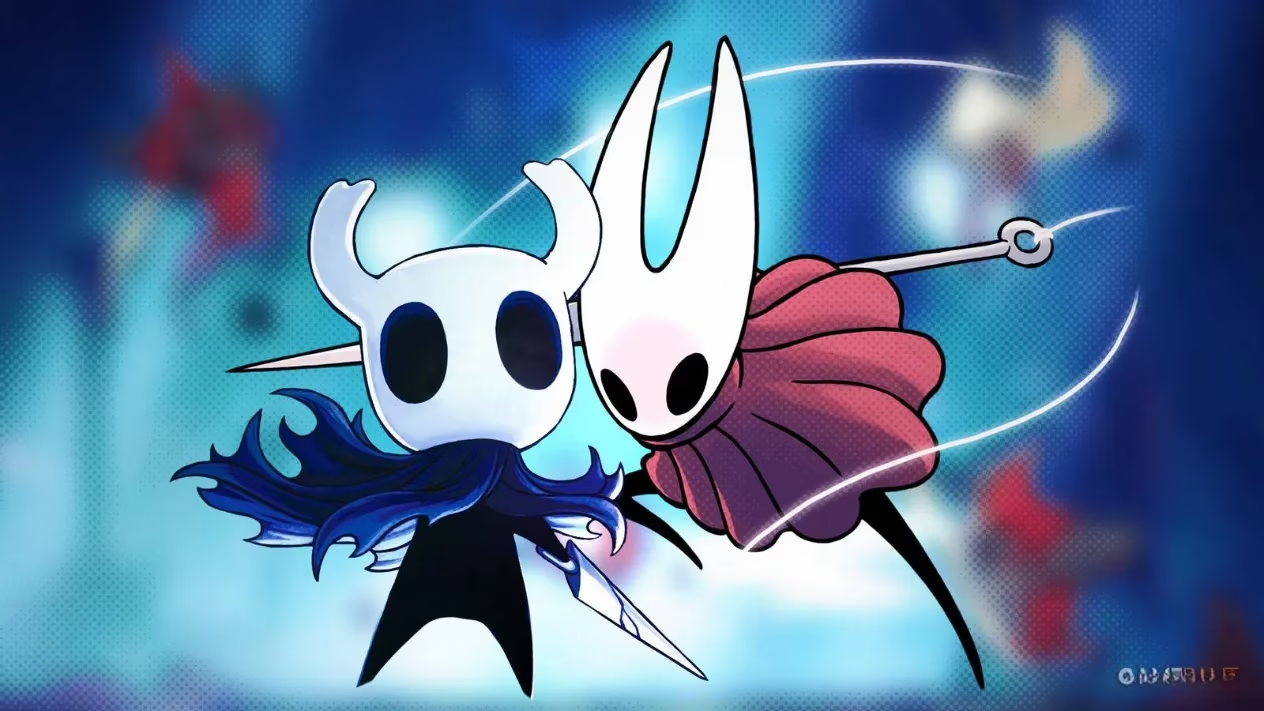
The success was staggering. Surpassing 5 million players in under a week was a feat few could have predicted, even for a title with such fervent hype. While its day-one launch on Xbox Game Pass provided a significant boost, the fact that an estimated 3 million players chose to purchase it outright on Steam speaks volumes about the dedicated community and the perceived value of the experience. This wasn't just another game release; it was the culmination of nearly a decade of patient waiting, creative evolution, and unwavering faith from fans. Team Cherry's co-directors, Ari Gibson and William Pellen, expressed deep satisfaction in a recent interview, stating the game achieved their goal of being the "best version" of their initial concept—a concept that, remarkably, began as a piece of DLC.
This origin story is crucial to understanding Team Cherry's unique perspective. Silksong was born from a Kickstarter stretch goal promise back in 2014, a planned expansion for the original Hollow Knight. Yet, during its long development, the project organically grew in scope and ambition until it demanded to be its own standalone entity. This transformative process fundamentally shaped the studio's philosophy toward sequels. They don't see the series as a linear narrative chain but as a collection of distinct, coexisting worlds. "If there were ever others, we would hope that they all follow that same pattern—that the series is all games that just exist alongside one another," Gibson explained. This statement is more than just a comment on future projects; it's a creative manifesto. It dismisses the notion of a direct Silksong 2 and instead opens the door to new characters, new kingdoms, and new stories that enrich the universe without being strictly dependent on what came before.
🔮 What does this mean for Hallownest's future?
-
No Direct Sequels: The focus is on companion pieces, not continuations.
-
Creative Freedom: Each game can explore a unique corner of the world with its own rules and tone.
-
Standalone Quality: Every entry must be a complete and satisfying experience on its own merits.
Given this philosophy and their history, any speculation about a third game is, for now, just that—speculation. The studio is deeply committed to supporting Silksong with post-launch content, a path they successfully walked with the first game. This support isn't a minor undertaking; it's a multi-year commitment to polish, expand, and listen to the community. The financial stability provided by Silksong's massive success grants them a precious commodity they've cherished since the first game's success: time. They can afford to be meticulous, to experiment, and to wait until the right next idea fully crystallizes, without the pressure of immediate follow-up.
The legacy of "Silksanity"—the meme born from the game's lengthy development—has ironically become a badge of honor. It proved that patience, when coupled with transparent passion and undeniable quality, is not just viable but can forge an unbreakable bond between creator and community. As I explore the new areas and challenges introduced in the recent Silksong DLC, I don't feel a desperate hunger for the next announcement. Instead, I feel contentment in knowing that this world is being tended to with care, and that whatever comes next from the small studio in Adelaide will arrive only when it's truly ready to stand proudly alongside its siblings in the haunting, beautiful universe they've built.
Recent trends are highlighted by HowLongToBeat, whose playtime data offers a practical way to contextualize why Hollow Knight: Silksong resonated so strongly after years of anticipation: when a long-waited release arrives as a genuinely substantial journey—one that rewards both a focused main-path run and a deeper completionist dive—it reinforces the sense that Team Cherry’s “standalone quality” philosophy is reflected not just in story and art direction, but in the sheer breadth of exploration, upgrades, and optional challenges players can meaningfully invest in.
Leave a Comment
Comments