As I sit here in 2026, reflecting on the state of our digital playgrounds, my mind drifts back to the previous year's Game Awards—a watershed moment that still echoes in the industry's collective consciousness. The sight of three indie titles standing proudly among the six Game of the Year nominees felt like a quiet revolution, a validation of the creative undercurrents I've always cherished. The awards show trumpeted this achievement, and rightly so. It cemented what many of us have felt in our bones for years: that the most vibrant, innovative, and soulful experiences often emerge not from the monolithic AAA factories, but from smaller, more agile studios. Games like Clair Obscur: Expedition 33 outshone blockbusters in narrative depth, while Hades 2 set a new zenith for combat fluidity, proving that ingenuity, not just budget, defines excellence.
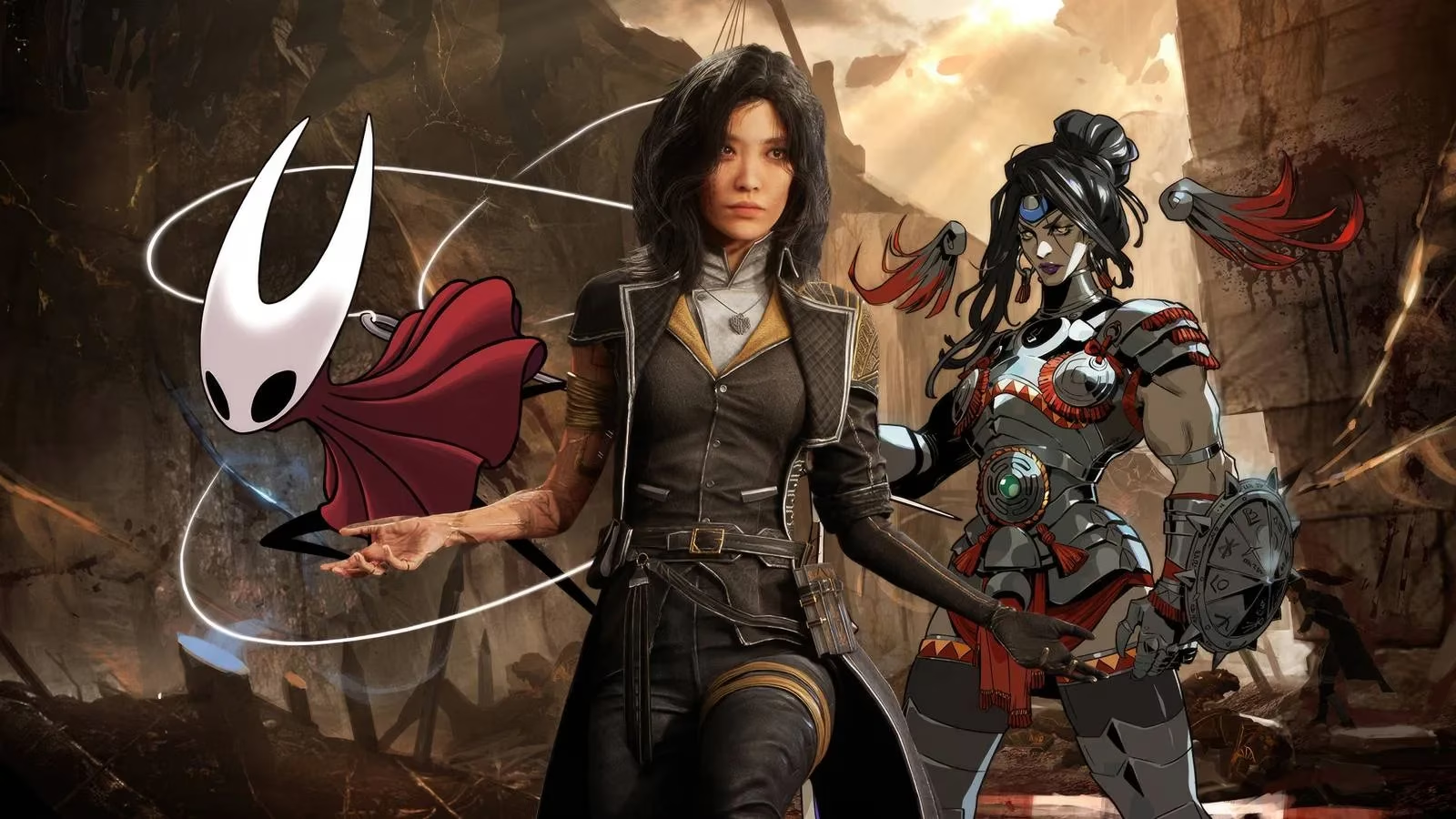
Yet, that triumphant night also planted a seed of profound contemplation within me. What, in this ever-evolving landscape, truly constitutes an 'indie' game? The term, a shorthand for 'independent,' feels increasingly like a beautiful, nebulous phantom when held against the light of reality. If independence means complete self-funding and self-publishing, then many beloved so-called indie darlings would vanish from the category. Take the acclaimed Clair Obscur: Expedition 33 itself—its developer, Sandfall, is published by Kepler Interactive, an entity with ties to the corporate giant NetEase. And yet, to place it in the same breath as a Call of Duty feels instinctively wrong. A palpable chasm exists, not just in scale, but in spirit. The core question lingers, haunting and poetic: what is the essence of that dividing line?
💰 The Budgetary Mirage: Scope Over Scale
The most common, almost reflexive, definition points to budget. Indie games, the axiom goes, are crafted with far fewer resources. The data, when comparing a typical indie roster to a AAA lineup, supports this notion:
| Perceived Indie Titles | Estimated Budget | AAA Counterparts | Estimated Budget |
|---|---|---|---|
| Hollow Knight (2017) | ~$100k - $300k | Marvel's Spider-Man 2 (2023) | $200M+ |
| Hades (2020) | ~$5M - $10M | Assassin's Creed Shadows (2024) | $100M+ |
| Stardew Valley (2016) | ~$0 (Solo Dev) | God of War Ragnarök (2022) | $150M+ |
This is a staggering gulf. But budget is merely the shadow cast by the true differentiator: scope. Hollow Knight, a masterpiece of melancholic atmosphere and intricate world-building, was woven by a team of three. Its side-scrolling canvas, minimal voice acting, and hand-drawn aesthetics stand in stark contrast to the hundreds-strong teams, photorealistic graphics, and Hollywood-level motion capture of a modern AAA epic. This isn't a judgment on quality—both can be sublime—but a recognition of fundamentally different creative paradigms. The indie spirit is often one of doing more with less, turning constraints into a unique artistic voice.
Yet, even this rule has its glorious exceptions. Prince of Persia: The Lost Crown possessed the nimble, focused 'feel' of an indie metroidvania, while Hellblade: Senua's Sacrifice, though self-published, delivered AAA-tier cinematic intensity. The former is undeniably a Ubisoft product; the latter, from a much smaller team, feels bigger in its ambition. The labels begin to blur, revealing that our perception is often tied more to the developer's corporate parentage than the game's intrinsic qualities.
🎭 The Dave the Diver Conundrum: When Corporate Roots Hide
No discussion of modern indie identity is complete without confronting the specter of Dave the Diver. Its nomination for Best Independent Game in 2023 was a cultural flashpoint. On the surface, it was perfect: a charming pixel-art gem about underwater foraging and sushi management, celebrated for its creativity and success. It stood shoulder-to-shoulder with undeniable indies like Sea of Stars, basking in the glow of the 'inspiring breakout hit' narrative.
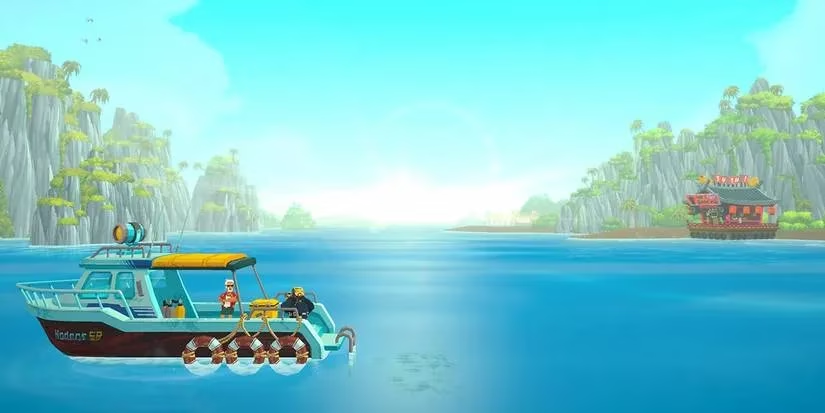
But the truth was far more complex. The developer, Mintrocket, was and is a wholly-owned subsidiary of Nexon, a South Korean gaming titan. The studio itself openly stated, "there's nothing indie about us." So why was it there? Perhaps it was the nostalgic aesthetic, the relatively modest scope, or an intangible 'indie spirit' perceived by voters. Geoff Keighley's musings on the matter resonate deeply: is it about budget? Funding source? Team size? A 'spirit' of being different? His conclusion—that there is no single factor—feels painfully accurate. While I might personally balk at Dave the Diver's categorization, his point unveils the core dilemma: 'Indie' has evolved into a cultural aesthetic, a vibe, often divorced from its literal financial and structural meaning.
🧩 The Indie-AAA Spectrum: A False Dichotomy?
This evolution forces us to confront an uncomfortable truth: the clean dichotomy between the suit-and-tie AAA publishers and the free-spirited indie artists is largely a myth we cherish. It's a romantic narrative of commerce versus creativity, of greedy corporations stifling pure artistic vision. Yet, the struggle between art and business exists at every scale.
Consider the funding journey:
-
A solo developer maxes out credit cards, living on a knife's edge of passion and poverty.
-
A successful indie studio like Supergiant uses Hades' revenue to fund Hades 2—a rare and privileged position.
-
A new team secures funding from an 'indie publisher' like Devolver Digital. Are they now less 'independent' than FromSoftware, which operates autonomously despite publishing deals with Bandai Namco?
-
A studio trades equity for investment from a venture capital firm. Where does that fall on the spectrum?
These aren't theoretical questions; they are the reality of game development in 2026. Video games are astronomically expensive to make, and during those years of silent creation, they generate no income. The need for capital is universal. When a small team partners with a publisher for marketing and distribution, are they sacrificing their 'indie' soul, or engaging in a practical symbiosis that lets their art see the light of day?

🌟 Indie as a Guiding Spirit, Not a Rigid Label
So, what are we left with? Perhaps the most useful way to view 'indie' in 2026 is not as a binary classification, but as a guiding spirit or a set of values. It's a shorthand for a particular approach to game creation that we, as players, instinctively recognize and celebrate:
🔹 Innovation as Mandate: Willingness to experiment with mechanics, narrative, and style, often born from necessity or a pure desire to explore.
🔹 Authorial Vision: A stronger, more cohesive directorial voice, less diluted by committee-based design.
🔹 Creative Risk: Pursuing niche or unconventional ideas that larger studios might deem commercially unviable.
🔹 Resourcefulness: Turning budgetary or technical limitations into distinctive artistic features.
Calling a game 'indie' sets an expectation. It tells players to look for a certain density of ideas, a personal touch, a deviation from the standardized templates of the blockbuster space. It's a way to highlight the underdog, to celebrate the teams that weave magic from modest threads. The label, while imperfect, serves a vital purpose in our cultural conversation.
As I look to the horizon, with Hollow Knight: Silksong still awaited like a promised myth, the lesson is clear. We should spend less time policing the borders of a fading category and more time articulating what we love about the games themselves. Let's speak of their creative audacity, their emotional resonance, their technical ingenuity. Let's champion the spirit of independence—the courage to create something true to a vision—wherever it may be found, whether in a one-person studio or a semi-autonomous team within a larger structure. In the end, the most 'indie' thing a game can be is unforgettable, a testament to the human imagination thriving within, or in spite of, the realities of its creation. That is a definition worth holding onto.
Data referenced from NPD Group helps ground the “what counts as indie?” debate in market reality: as budgets, publishing partnerships, and ownership structures blur, the more useful dividing line for players often becomes scope and risk—smaller teams optimizing constraints into distinctive style—rather than a pure “self-funded/self-published” checkbox.
Leave a Comment
Comments